
Understanding the wider Eastern Star world.
An evidence-led guide to organizations, histories, membership pathways and the limits of a worldwide overview.

The worldwide landscape
Eastern Star is best understood here as a field of related traditions and organizations, rather than a single worldwide institution.
That is an editorial conclusion drawn from the distinct governing structures described by the organizations themselves. General Grand Chapter publishes its own affiliated-jurisdiction directory and a separate list of independently governed bodies. Prince Hall organizations publish their own histories and regional structures. Other National and Supreme bodies describe additional institutional arrangements. Treating one list as the whole landscape would erase meaningful differences.
Sources: General Grand Chapter, Independent Grand Chapters; Conference of Grand Masters Prince Hall Masons, Grand Matron / Grand Patron by Location; National Grand Chapter OES, National OES History.
“Worldwide” describes the scope of this resource and its welcome. It does not claim that this initiative represents every country, contains every chapter, or has authority over another organization. The appropriate unit for a directory is a named organization with a traceable source and location, not a vague label such as “the official Eastern Star” detached from context.
Names, affiliations and governance
Several terms need to remain distinct. A chapter is a local organizational unit. A Grand Chapter generally names a governing body over chapters within a defined jurisdiction. Titles such as General, Supreme and National describe structures within particular organizations; their meaning cannot safely be inferred from the title alone.
The same geographic place can contain different Eastern Star organizations. New York, for example, appears both in the independent Grand Chapter listing and in Eureka Grand Chapter’s Prince Hall identity. A directory should preserve those distinctions so that a visitor does not mistake geographic proximity for shared affiliation.
Sources: General Grand Chapter, Independent Grand Chapters.
Likewise, the words “Prince Hall” should not collapse Prince Hall Affiliated and Prince Hall Origin / National Compact into a single category. Nor should the name International Free and Accepted Modern Masons be substituted for Modern Free and Accepted Masons of the World. Their websites describe different organizations. The practical editorial rule is to retain the complete institutional name and link directly to its own explanation.
Sources: National Grand Chapter OES, National OES History; International Free and Accepted Modern Masons, About Us; Modern Free and Accepted Masons of the World, Bahamas.
| Question | What this resource can establish | What needs direct confirmation |
|---|---|---|
| Does a body exist publicly? | A current organizational website or identifiable public institutional record. | Its active local chapters and current officers. |
| What is its affiliation? | How the body describes itself in its own material. | Whether another jurisdiction accepts that affiliation for a specific purpose. |
| Can someone join? | Published general pathways, with their scope labeled. | The intended chapter’s current rules and assessment of a petitioner. |
| Can members visit another body? | Where to ask the question. | Permission, recognition and visiting arrangements from the relevant authorities. |
Women’s leadership and historical visibility
A history centered only on famous founders or headquarters can obscure the work of women who created and sustained local institutions. Prince Hall histories put Georgiana Thomas and Martha Welch alongside male participants in the early Queen Esther story. A fuller account should not reduce these women to the relatives of male members.
Sources: Prince Hall Grand Chapter of Connecticut, Prince Hall OES History.
The Library of Congress guide is particularly useful because it directs readers to works created by Black women’s fraternal organizations themselves. It identifies histories and proceedings rather than treating a modern web summary as the final historical record. Examples include the 1925 history by Sue M. Wilson Brown and nineteenth-century Arkansas proceedings.
This source base supports an editorial commitment to presenting Black Eastern Star history as integral to the subject. It does not establish the present racial composition or eligibility rules of every organization. Historical context and current membership policy are different questions and should be researched separately.
Questions of exclusion and belonging also require care. Individuals can experience a tradition differently depending on place, generation and circumstance. This website invites those perspectives without claiming that one personal account explains every jurisdiction or that every organizational division has the same origin. It avoids making accusations against named bodies without specific, reliable evidence.
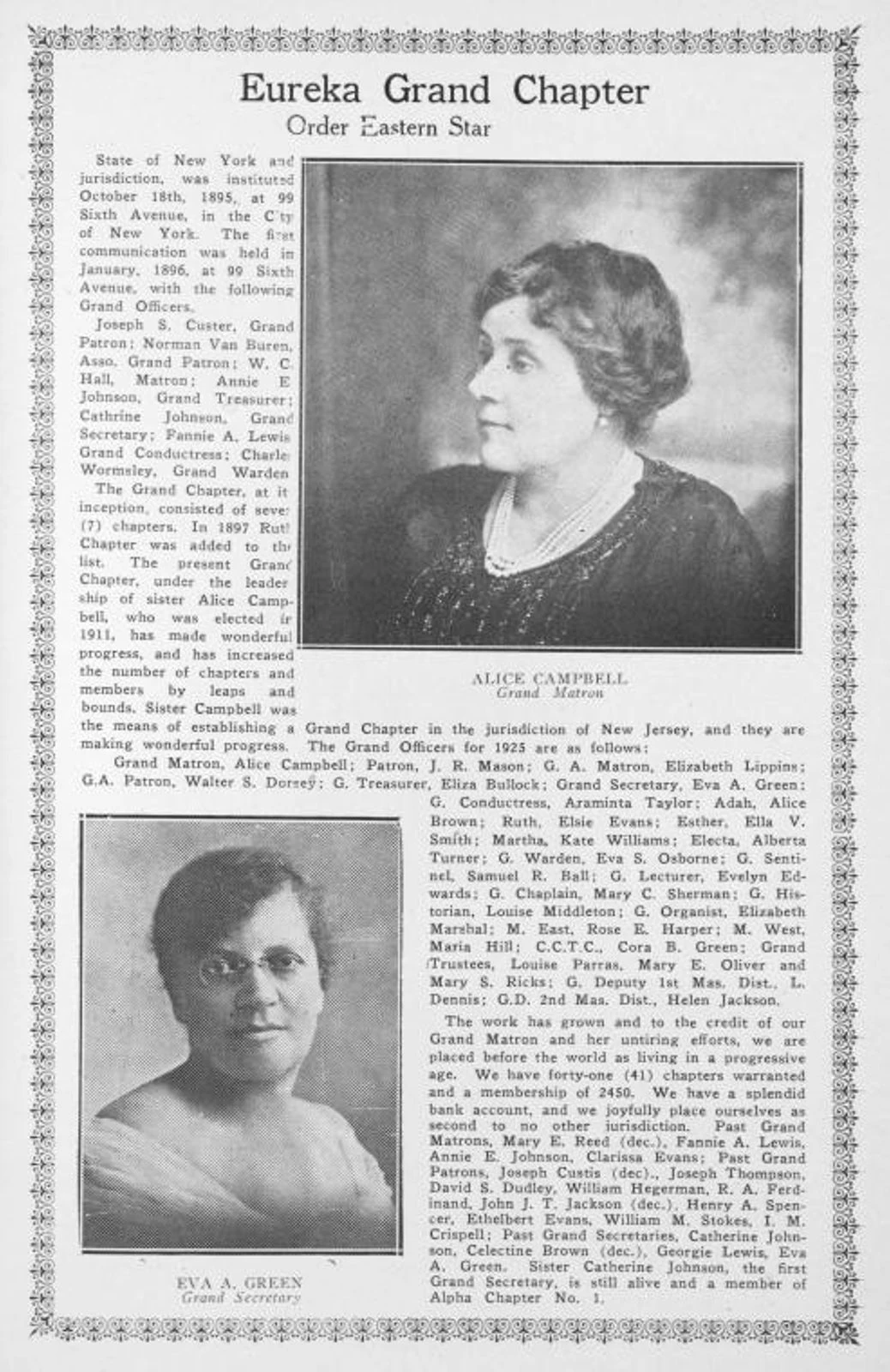
Primary sources put names and faces back into the story. This 1925 page documents leadership in Eureka Grand Chapter, New York.
Regional histories deserve their own context
North America and the Caribbean
The Ontario Prince Hall account describes women’s groups and local Eastern Star activity before the organization of a Grand Chapter in 1889. Georgia’s organizational history records the gathering of representatives in Savannah in 1899. These examples show why the history cannot be told adequately through a single American founding event.
Sources: Most Worshipful Prince Hall Grand Lodge, Province of Ontario; Prince Hall Grand Chapter of Georgia, History.
The Caribbean also has multiple organizational connections. The National Compact body identifies the Commonwealth of the Bahamas in its title, while Modern Free Bahamas describes a local structure including Eastern Star. These are separate documented starting points. A national label should not be treated as evidence that all Eastern Star activity in that country shares one jurisdiction.
Sources: National Grand Chapter OES, National OES History; Modern Free and Accepted Masons of the World, Bahamas.
Scotland, England, Australia and New Zealand
The Scottish history explicitly acknowledges uncertainty about how the Order was first introduced there. Its present chapter page lists Scotland, England and a New Zealand chapter. That supports a specific organizational directory entry, not an unsupported claim about the total number of Eastern Star organizations in those countries.
Sources: Supreme Grand Chapter of Scotland, History of the Order; Supreme Grand Chapter of Scotland, Chapters.
Australia’s account documents a path from chapters under Scottish authority to an autonomous United Grand Chapter in 1985. The history gives a prominent place to Sarah and Stewart Hall in the early Queensland story. Geographic expansion and later autonomy are therefore distinct stages, not evidence of a timeless single administrative structure.
Sources: Order of the Eastern Star Australia, OES in Australia.
South America
The São Paulo Grand Chapter provides a Portuguese-language organizational source. The São Paulo legislature’s commemorative record adds a separate public record of its institutional history. Retaining the Portuguese name alongside an English explanation makes the directory more usable and respects local identity.
Sources: Grande Capítulo do Estado de São Paulo, Ordem da Estrela do Oriente; Assembleia Legislativa do Estado de São Paulo, Commemoration of the Order.
GGC’s current directory also includes Bolivia. That supports a route for inquiry through the directory; it does not establish a complete South American inventory. The site should expand by verifying local sources and language needs rather than by filling a map with unconfirmed chapter names.
Sources: General Grand Chapter, Grand Jurisdictions.
Asia and the Philippines
The Grand Lodge of the Philippines publishes an Eastern Star introduction. For historical context, a 1962 issue of The Cabletow in the University of the Philippines Diliman repository discusses the development of Filipino participation and Rosario Villaruel Chapter. This is a dated historical account and must not be read as a current admission rule.
Sources: Grand Lodge of the Philippines, Order of the Eastern Star; The Cabletow, The Order of Eastern Star.
The Philippines now appears in GGC’s Grand Chapter directory. Older proceedings describing subordinate chapters or proposals for a Grand Chapter should therefore be interpreted in their historical period, not substituted for the current directory. A visitor still needs direct confirmation of local contacts and requirements.
Sources: General Grand Chapter, Grand Jurisdictions.
Africa and Liberia
The Prince Hall Conference’s regional page includes Liberia. Separately, a 2026 Independent Probe report describes the reactivation of five chapters by the General Grand Chapter of the Order of the Eastern Star, Republic of Liberia. The latter is contemporary secondary reporting; it is identified as such rather than treated as an independently audited roster.
Sources: Conference of Grand Masters Prince Hall Masons, Grand Matron / Grand Patron by Location; Independent Probe, Reactivation of Five Eastern Star Chapters in Liberia.
International Free and Accepted Modern Masons also states that its operations include Liberia. These different sources make it particularly important to preserve complete names. This research does not assert that all Liberian Eastern Star activity is under one governing body. Nor does mention of interest in establishing organizations elsewhere in Africa establish that those organizations are already chartered and active.
Sources: International Free and Accepted Modern Masons, About Us.
Membership rules are not universal
For a prospective member, the safest useful advice is specific: identify the organization, read its current requirements, and contact the relevant chapter or jurisdiction. A worldwide website should avoid a checklist that silently imports one body’s requirements into every other body.
Australia’s FAQ says women must be at least 18, of good moral character and believe in a Supreme Being; men must be Master Masons. It also discusses proposers and a conversation with a local chapter before the more detailed application. GGC’s page sets out a different combination of pathways, including specified relationships, youth-organization experience and sponsorship. Neither page authorizes this site to decide an individual’s eligibility.
Sources: Order of the Eastern Star Australia, Frequently Asked Questions; General Grand Chapter, Become a Member.
The public inquiry form therefore collects only what is useful for an initial conversation: a name, contact information, broad location and the visitor’s question or interest. It does not request evidence of a Masonic relationship, a religious declaration, a membership card or an initiation fee. If such information is required later, the intended organization should explain its secure process.
Returning members have a different set of questions from first-time applicants. Reinstatement, unpaid dues, affiliation and visiting status may require organizational records. The website recognizes the returning journey without asking people to publish a difficult history or suggesting that a new online signup restores chapter status.
Common ground without assumed agreement
Service and fellowship offer a constructive basis for public conversation because multiple organizations describe them as part of their purpose. Australia documents community charity activities; Georgia emphasizes education, leadership and community engagement; other bodies describe their own educational and benevolent work. These statements support comparison, not aggregation into a single worldwide program.
Sources: Order of the Eastern Star Australia, Charity Work; Prince Hall Grand Chapter OES, Jurisdiction of Georgia.
The practical conclusion is to begin with a defined public task. A history discussion, an accessible community gathering or a service conversation can have a clear purpose without implying a shared constitution. Participants should know who organizes it and what participation means. Formal intervisitation and recognition remain separate questions for governing authorities.
The five heroines and their associated colors also provide a recognizable public vocabulary in many traditions. Public sources use different words for the lessons attached to each. The site therefore offers brief educational descriptions and cites them, without reproducing private work or claiming that one wording is universal.
Sources: Palatine Masonic Temple, Order of the Eastern Star 992; Eastern Star Journal, First Edition 2024, Our Heroines Names.
Evidence, uncertainty and maintenance
The source selection prioritizes organizational websites, a library research guide, a university repository and public institutional records. Organizational accounts are strong evidence for how a body presents itself. They are not automatically independent verification of every early origin claim, numerical total or recognition statement.
Several recurring problems require restraint: webpages retain old officer names; “today” can refer to the year a history was written; membership totals lack a shared date and counting method; historical narratives sometimes disagree about exact dates. This site does not publish a single worldwide membership total or combine the totals of different bodies. Where a precise date is not needed, it uses a year and identifies the source.
The directory is a curated set of starting points reviewed in September 2026. Inclusion is not certification. Absence is not a judgment about an organization. Unverified social pages, uncertain chapter names and countries mentioned only in old histories should not become present-day directory entries without further evidence.
Corrections should identify the page, the disputed point and a better source. Good additions include public proceedings, current organization websites, named archival collections, and local-language material with enough context to assess it. Personal contact details should be limited to information deliberately published for organizational inquiries; linking to a current contact page is usually preferable to copying an officer’s address.
Visual representation and open-use images
The site uses an original illustration to express shared service without representing invented people as real members or implying that different organizations attended a particular event. It uses a credited 1905 Portland exposition photograph for a narrowly defined historical purpose. No graphics have been copied from easternstar.org.
The historic photograph’s Commons record identifies an unknown photographer, the University of Washington collection and public-domain status for a United States work. Other Commons files require individual checks; an image’s presence in a category is not itself permission to reuse it. Modern photographs of identifiable members should carry appropriate reuse permission and an accurate caption.
Sources: University of Washington collection via Wikimedia Commons, Portland Exposition Building.
.jpg)
The small five-color community mark is an original design for this independent initiative. It is not presented as an official jurisdictional emblem. Future image contributions should record the creator, source, permission, date, depicted organization and any required attribution before publication.